From the galley to the engine compartment, the risk of boat fire at sea is a challenge won through prevention: a practical guide combining regulations, common sense, and useful tips to navigate in total safety.
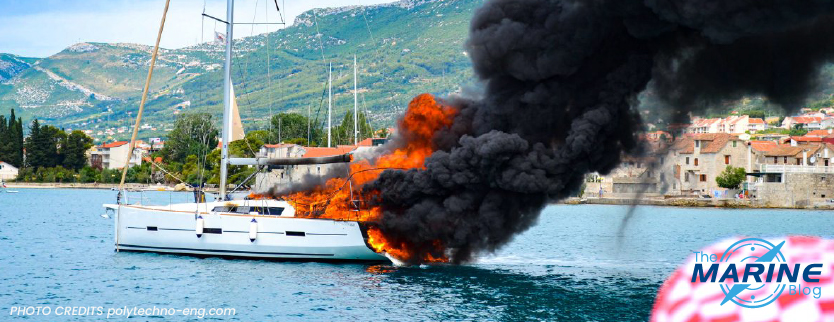
Sailing means freedom, but it also requires a deep awareness of the risks that hide among the waves. Even though water surrounds the vessel, a boat fire remains one of the most dreaded and complex emergencies to manage for anyone who goes to sea. In a confined space, surrounded by resinous materials, fabrics, and fuel, a spark can turn into a disaster in just moments.
A skipper’s mastery is measured not only by the ability to maneuver the boat, but above all by prevention and safety management.
The Anatomy of Danger: The Fire Triangle
To understand how to avoid the worst, you must know the “enemy.” A fire is born from the fatal meeting of three elements, known as the fire triangle. There are a fuel (wood, fiberglass, fabrics), an oxidizing agent (oxygen in the air), and a heat source (a spark, a short circuit, or an open flame).
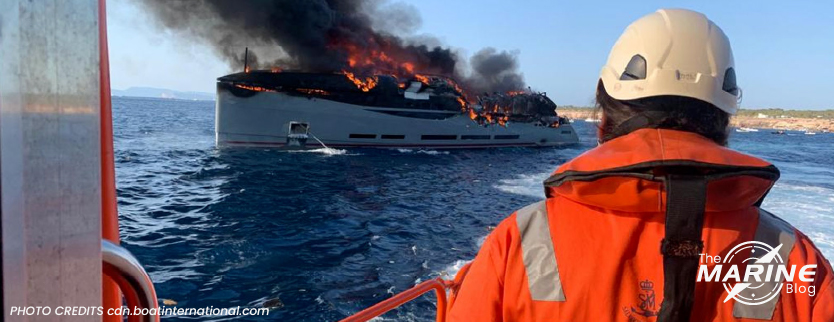
On a boat, separating these elements is a constant challenge. Almost everything around us, from upholstery to sails, is potentially flammable. When you add that the wind, a faithful companion of navigation, acts as a giant bellows on the flames, it becomes clear why speed of intervention is vital. Closing portholes and hatches can help limit the influx of oxygen, but it is often not enough to suffocate a fire that has already started.
Panic Paralysis and the Urgency of Action
In the face of a sudden flare-up, even the most elementary actions—such as throwing a blanket or a towel to suffocate the source—cease to be immediate. The mind falters, and time at sea accelerates at a frightening pace. People often think of the classic bucket of water as an emergency solution. But the reality is much more complex. Retrieving the bucket, filling it, and carrying it through a rolling environment, across slippery surfaces and narrow corridors, consumes precious seconds that could mean the difference between a minor incident and an irreparable disaster.
In these critical situations, alongside acoustic alarms and smoke detectors, the most powerful weapon remains the fire extinguisher. However, its effectiveness depends not just on its internal charge, but on the crew’s familiarity with it. Knowing how to locate it in the dark, pulling the safety pin with a steady hand, and aiming the spray precisely at the base of the flames requires clear-headedness—a trait that panic tends to erode rapidly. Physical and technical preparation, in this sense, must go hand in hand with psychological readiness. Knowing the exact location of every firefighting device is a duty that precedes navigation itself.
Fire Extinguishers: Beyond Legal Obligations
Beyond the correct use of extinguishers, nautical regulations are clear: the required complement of extinguishers depends on the boat’s certification (CE or pre-CE) and engine power. However, the law is often “minimalist.” For a 10-meter vessel with several cabins, a single fire extinguisher is definitively too little.
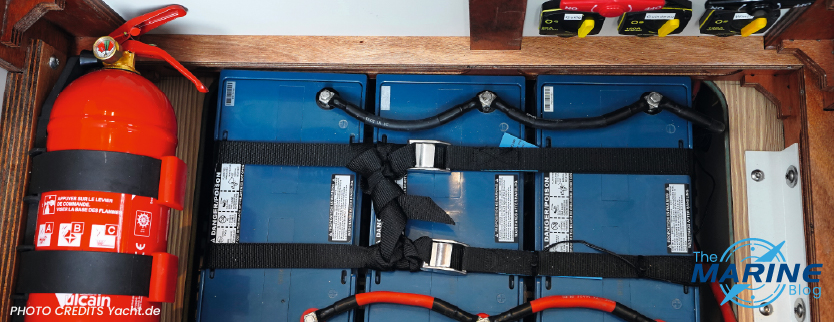
Experts advise against skimping on safety. It is wise to place an extinguisher in the cockpit and at least two below deck, in strategic spots like the companionway and the forward cabins. Choose dry powder models with a good extinguishing capacity, checking the number preceding the letter of fire class B, and remember to shake them periodically to prevent the powder from compacting, which would render them useless in the event of a boat fire. An excellent, inexpensive, and space-saving addition is a fire blanket, ideal for taming small galley fires in an instant.
The Heart of the Risk: The Onboard Galley
Statistically, the galley is the place where most fires break out. Narrow spaces and the proximity of burners to textile materials create an explosive mix. Whether you use alcohol (particularly insidious for flame management), kerosene, or the more common LPG gas, maximum caution must be exercised.
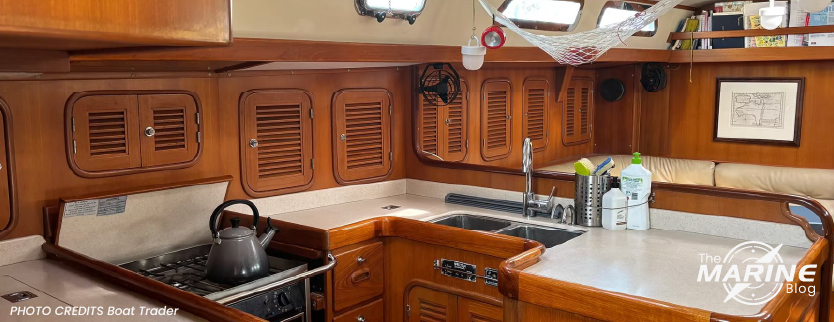
A simple distraction, like a dish towel left near the burners or a splash of boiling oil, can trigger a disaster. It is fundamental that the stoves are equipped with a thermocouple and that the gas circuit is always turned off at the source (on the cylinder) after use. Since LPG is heavier than air and tends to settle invisibly at the bottom of the bilge, installing an acoustic gas detector is an investment that can save lives.
Electricity and Engines: The Invisible Dangers
While the galley represents the “visible” risk, the electrical system is the hidden one. The marine environment attacks contacts, causing oxidation and current leakage. Undersized cables or loose connections can overheat silently. A periodic “tactile” check (feeling by hand if terminals are hot after use) and checking the fuses are mandatory steps for any conscientious owner. For batteries, it is better to choose gel models, which do not emit flammable hydrogen gas and require less maintenance.
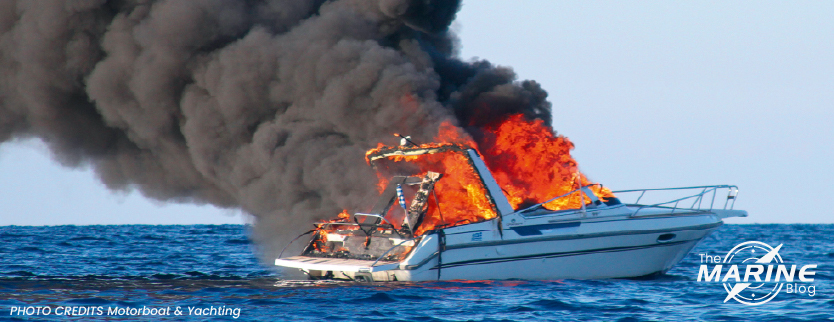
Finally, the engine compartment. Although diesel is less volatile than gasoline, it still requires cleanliness and insulation with fireproof materials. Always check the efficiency of the fuel shut-off valve, the emergency device that stops the flow of fuel. And for those using outboards: gasoline canisters must be approved, well-secured on deck, and never stowed in enclosed spaces unless completely emptied.
The Weight of Command: Responsibility and the Duty to Rescue
It is worth remembering that managing a boat fire emergency is not just a matter of survival, but a specific legal and moral obligation. The commander of the vessel bears ultimate responsibility on their shoulders. It is not just about ensuring that the boat complies with current regulations and onboard equipment, but about actively taking charge of every rescue maneuver.
The skipper’s duties regarding firefighting are:
- Carrying specific equipment: In addition to equipping the boat with firefighting gear, its reliability must be checked periodically, and maintenance must be carried out according to the parameters specified by the manufacturers and current legislation.
- Instructing the crew: The crew must always be informed about the precise location of the firefighting devices on board and trained on how they operate.
- Enforcing the rules: Rebuking and preventing any careless or dangerous behavior by any crew member during normal life on board.
Protecting human life, limiting structural damage, and attempting every possible way to extinguish the fire are tasks that require an unbreakable mix of seamanship and courage.
Keep following The Marine Blog to stay up to date with tips, insights and best practices for enjoying the sea more safely.