Mandatory by law, colored flares are essential equipment for being spotted and signalling an emergency at sea. Here is what they are, how and when to use them safely, and how to dispose of them properly once they have expired.
Signal flares or so called colored flares are an essential part of safe navigation on board ships and yachts. They serve to signal emergency situations, such as man overboard, to be spotted and above all to guide rescuers to their position. Just like the VHF radio or life jackets, they are among the mandatory equipment to have on a boat and the entire crew should be instructed on their exact location on board and their correct use in emergencies.
In fact, despite their importance, flares are still a rather ‘mysterious’ object for many yachtsmen who know little about them and do not know how to use them effectively and safely. Although they are in fact the subject of an examination for the boating licence, no practical exercises are included in the syllabus. This is a serious shortcoming given that these are dangerous accessories which, once ignited, reach high temperatures and if not used correctly, can cause burns and scalds, as well as starting fires on board.
Let us then take a detailed look at what colored flares for nautical use are and their main characteristics, how many of them must be on board a pleasure boat according to current regulations, and when and how to use them safely. Since they are, to all intents and purposes, pyrotechnic devices subject to an expiry date, let us also see how to dispose of them correctly.
An ingenious invention by engineer Martha Coston
Being able to be spotted when an emergency occurs at sea is crucial and can make a real difference in rescue operations. Seafarers have always had this need and have been ingenious in finding suitable devices for the purpose. The first signal flares for marine use were patented in 1859 by US engineer Martha Coston and were used in the fleet of the US Navy.
Since then, thousands of lives have been saved through their use by military personnel, maritime personnel and yachtsmen themselves in emergency situations at sea, and they are still the most popular means of signaling at sea today.

The two types of nautical colored signal flares
The signal flares or colored flares that are used at sea generally fall into two categories. There are those that emit light and those that emit smoke. It is important to know the difference and to know when to use each type. Flares that emit a bright light are hand flares and parachute flares. Both are ideal for use in low-light conditions or at night, while during the day they become much less conspicuous and effective for detecting one’s position.
Hand flares have a limited range of visibility, so they should be used near the coast or other vessels. Parachute rockets, on the other hand, once fired, reach a height of about 300 metres and descend slowly, as they are slowed down by a small parachute, and can be spotted up to 25 miles away.
Smoke-emitting rockets, on the other hand, are what are known as ‘smoke jets’ and work best in daylight, when a large cloud of smoke on the horizon is something that people can notice even from a considerable distance (up to 5 miles).

How many rockets on board? Depends on the distance from the coast
The number of flares to have on board a pleasure boat, be it a sailboat, motor yacht, dinghy or boat, depends on how far you sail from the coast and is subject to specific regulations. In Italy, according to the Nautical Code updated by the recent Decree No. 133 of 17 September 2024) there are three sets of flares:
Within 3 miles: 2 hand flares and 1 smoke buoy
Within 50 miles: 2 hand flares + 2 parachute flares + 2 smoke buoys
Without Limits: 3 hand fires + 3 parachute rockets + 2 smoke jets
The same Decree No. 133 also provides for the possibility of replacing hand-held flares with modern LED flares that comply with the standards of the international Solas Med (Safety Of Life At Sea) convention for the protection of life at sea and in accordance with Imo (International Maritime Organisation) standards. They are innovative devices, less dangerous and easier to dispose of, but are currently only available in the US market.

How to use colored signal flares safely
As a general rule, colored flares should only be used if they are likely to be seen by other passing boats or vessels, or by the professional boats used by rescuers, such as the Stem-12-Fire-Rescue, Stem 12 Ambulance and Stem Ten Patrol.
Keep in mind that the curvature of the Earth creates our ‘horizon’ which greatly affects our visibility.
Flares can also be dangerous, as they emit sparks and reach high temperatures, so they must be used correctly. It is always a good idea to check the instructions on the outer label and to wear a pair of protective gloves.
Lighting hand fires, rockets and buoys
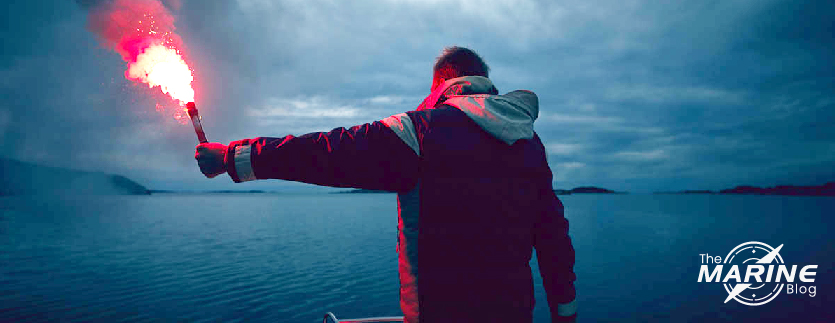
Lighting hand-held fires is very quick: you have to unscrew a cap and activate the rocket in one go. The light produced is very strong (we are talking about the equivalent of more than 15,000 candles). You have to hold the rocket well up by extending your arm to make it even more visible to the rescuers. The light lasts for about 1 minute. Instead, the parachute rocket must be launched downwind, using a special rocket gun, at an optimum angle of 45 degrees.
Finally, the buoy must be opened by unscrewing the special cap, and pulling hard on the pull-ring, and then immediately thrown into the sea. In just a few moments, smoke will begin to escape and will continue to do so even if the flask gets wet or capsizes.
Expired rockets? Here’s how to dispose of them properly
It is important to know that distress flares at sea have an expiry date (4 years). At the end of their expiry date, they must be disposed of properly as they are potentially dangerous pyrotechnic devices. In Italy, the law stipulates that the person who sells them, i.e. the retailer, must be responsible for collecting expired distress flares free of charge. While the manufacturer or importer is responsible for organising the collection, transport and disposal. Dangerous and illegal alternatives, such as shooting them on New Year’s Eve, throwing them into the sea or into rubbish bins, should be avoided at all costs.
In the interests of safety, the flares should also be neutralised in any case. An effective method is to immerse them in water in order to soak the powders and thus render them harmless.
To get to know the sea topics better, visit The Marine Blog!