Find out how the new Stem 50 interprets the concept of safe navigation and what safety equipment it needs to take on board to ensure carefree sailing in line with current nautical regulations.
Navigational safety is a crucial issue for a sailing cabin cruiser and safety equipment plays a key role in ensuring secure journeys. It is the sea itself, as a treacherous and inconstant natural environment, that demands a careful approach and awareness of the risks involved. A rigour that must be implemented first and foremost by the sailors themselves who take on day trips, cruises and long voyages. But also by designers, shipyards and equipment manufacturers who, on the safety front, must propose adequate, efficient and up-to-date solutions. Lastly, there is the legislator who, in regulating all matters of navigation and the management of boats and yachts, must propose clear, scrupulous and up-to-date regulations to guarantee all sailors maximum safety on board.
So let’s see how a modern, up-to-date and technological sailing cabin cruiser such as the Stem 50 interprets the concept of safety on board and what equipment it must take on board once in the water to ensure carefree sailing for owner and crew.
The Stem 50 is already dedicated to safety
The Stem 50 is a 16-metre cabin cruiser in the “Blue Water” category, and therefore dedicated to offshore sailing, in the Mediterranean as well as in the ocean. And precisely to meet the needs of demanding sailors who want to sail as a family or with a small crew, it is a yacht that was already born with a special vocation for safety. After all, this is a crucial theme for those who are making it: the company Stem Marine of Parma. Stem Marine is one of the world leaders in the design and construction of equipment and devices for rescue and fire-fighting.

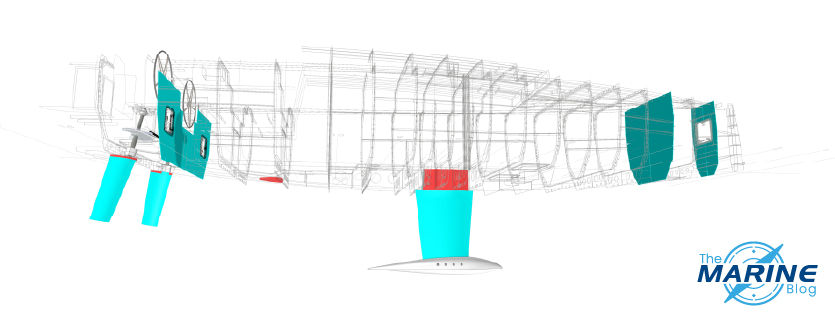
The Stem 50 is made from marine aluminium. This material makes the boat extremely robust, rigid and capable of withstanding major impacts against rocks, drifting objects and other seagoing craft. To further raise the boat’s safety level, French designer Nicolas Purnu decided, together with the yard, to insert “crash box” in the bow and stern, as in the best ocean racing cabin cruisers. In addition, both the keel and the two rudder blades are made from a solid block of aluminium and shaped by chip removal to guarantee unrivalled strength. This is increasingly in demand among sailors, given the many cases of accidents involving drifting objects and debris, as well as frequent attacks on boats by cetaceans.

Easy Sailing’ philosophy and maximum attention to critical details
The concept of sailing safety is then declined on board Stem 50 through the “Easy Sailing”philosophy. This philosophy makes it as easy as possible to steer the yacht in all weather conditions and even with a small crew. Helmsman and crew can count on a double automatic pilot, halyards and sheets deferred in the cockpit and electric winches. The deck equipment is optimized for load optimisation and the yacht is equipped with a well-dimensioned set of sails (including the self-tacking foresail). The sails have no flywheels and are designed for fast reduction in the event of wind reinforcement. Onboard, the safety equipment includes the most innovative devices for consulting nautical charts, automated pilotage and route planning.

Design details and commitment to safety, safety equipment
The feeling of safety when sailing on the Stem 50 is also expressed in many other details. These include the cockpit, which is protected by the Hard Top and windscreen. Additionally, there are handrails distributed in strategic areas of the deck, the integrated stanchion and the sturdy dolphin guard. The on-board equipment itself has been the subject of a careful study for an ideal location that facilitates the crew in any emergency situation. An example? The life raft compartment is located aft in a special locker flush with the waterline. Also below deck, in the Stem 50’s most hidden corners, are quality electrical wiring and Trudesign welded inboard sea outlets.
For example, Stem Marine has paid special attention to the engine compartment ventilation circuit that runs through the aft crash box. The circuit is made with high-strength polyethylene pipes, which guarantee their integrity even in the event of extraordinary events. Not to mention the no less than 7 bilge pumps installed on board. In short, nothing is left to chance on this cabin cruiser. It can sail for a long time, in all conditions and with maximum crew peace of mind.
 |
Stem 50 |
Safety equipment: Lifejackets, life rafts and distress signals
Once the Stem 50 has been put in the water, it is then the owner’s prerogative to equip the yacht with safety equipment required by the Nautical Code. The whole matter in Italy has recently been redefined by Decree No 133 of 17 September 2024 which came into force on 21 October 2024. So let’s see what equipment must be carried on board the Stem 50.
In addition to the Life Raft for navigation beyond 12 miles from the coast, but already included in the Stem 50’s equipment, there are Life Jackets, one for each person on board. According to the Decree, the lifejackets must be stamped with the duration of validity established by the manufacturer and must bear the initials and registration number of the Stem 50 or its identification number registered in the Central Telematic Archive of Pleasure Craft (ATCN).The vests themselves must also be fitted with an Automatic Activation Light.

Other required safety equipment on board Stem 50s are the Distress Signals, i.e., hand flares, parachute flares and smoke jets, which must be present in the appropriate kits according to the distance from the coast:
- Within 3 miles (2 hand flares, 1 smoke buoy)
- Within 50 Miles (2 hand flares, 2 parachute flares, 2 smoke buoys)
- Unlimited (3 hand fires + 3 parachute rockets + 2 smoke jets)

Complementary mandatory safety equipment
Other equipment that must be carried are the Epirb. They can also be replaced by a satellite phone, the Compass, which can be magnetic or electronic, a Lifebuoy, the Black anchor flask, the Clock, and the sound beacons, i.e. Whistle and Bell.
Finally, as of 21 October 2025, 3 more must be added to these endowments:
- Table of Day and Night Visual Signals of the International Regulations for Preventing Collisions at Sea (Colreg).
- A sounder that can be electronic or manual.
- Safety harness (one for each person on board), with an attached safety umbilical strap approved to ISO standards and CE certified.The harness can be integrated with a lifejacket.
Conclusions
In conclusion, boating safety starts with the boat, the way it is built and its philosophy. Stem 50 on this front offers the maximum guarantee and the culture of a yard that has been working on safety for over 30 years. The onboard safety equipment complies with all current regulations, ensuring secure navigation. Lastly, there is the owner’s approach, his style of sailing, his experience in facing the sea, and his ability to prevent and manage all those situations that the sea throws at us. This is, after all, the essence of being a true sailor!