Aluminium sailing boats have always held a certain fascination among adventurous sailors. Today, however, these cabin cruisers feature much more sophisticated, state-of-the-art designs and technical solutions in line with the modern yachtsman’s need for comfort and ease of use. We have already explored the differences in the use of fiberglass and aluminium. In this article, we will dive into the world of aluminum sailing boats, discovering how their design has evolved over time.
In recent years, aluminium boats have come back into fashion among yachtsmen. What used to be “all around” cabin cruisers, solid, dedicated to safety, without too many frills and favoured exclusively by a narrow circle of globetrotting sailors, have lately become much more comfortable, aesthetically beautiful. They are gaining a certain “appeal” even among ordinary sailors, lovers of “offshore” sailing.
It should be emphasised that, in terms of design, modern aluminium boats have made giant strides compared to the past. Those who turn to this type of cabin cruiser today will find a refined look, plenty of technology and comfort to spare. So let’s see how aluminium sailing yachts have changed over time and which aspects of design have evolved the most.
History of aluminium sailing boats
The history of aluminium sailing boats is relatively short. Apart from a few simple dinghies and a few racing prototypes made in the late 19th century, such as the famous Defender for the America’s Cup designed by Nathanael Green Hereshoff, the first real aluminium sailing boat was the ‘Gulvain’ conceived in 1949 by French designer Laurent Giles. That innovative boat won the ‘Trans Atlantic Race’ (race from Bermuda to Plymouth) twice. It was mentioned in several books and even had a prestigious painting dedicated to her.
It was only in the mid-1960s, however, that the construction of aluminium yachts took off in Europe. Among the first shipyards to adopt this metal was the German Abeking & Rasmussen. In 1965, they began mass production of yachts with lengths of 20 to 40 metres, often based on designs by Mac Lear & Harris and especially Sparkman & Stephens. The yard that nevertheless paved the way for the world of aluminium in yachting was the French Meta, founded in 1967 by Jean Fricaud and his son Joseph.
Aided by some lucky ocean boats, such as the legendary ‘Damien‘ on board which sailors Jérôme Poncet and Gérard Janichon completed several round-the-world voyages.
From then on, aluminium boats caught on among yachtsmen. Construction spread to other countries, such as England and Holland. Although they remained a niche in the nautical market, these sailing yachts have always maintained a certain interest. Above all, shipyards and designers have never stopped improving them, in their shapes and fittings, so much so that today they are very different from the past and appeal to all lovers of cruising under sail.
Why aluminium sailing boats appeal to cruisers
The reasons for the success of modern aluminium sailing yachts are to be found in the renewed desire for adventure. This desire is driving more and more owners to make long sailings and ocean crossings. Some even go as far as exploring impervious and desolate parts of the planet in search of peace, solitude and wilderness. But there is also a large segment of yachtsmen who simply choose life on a boat. Thanks to the new possibilities of working remotely, spend long periods on board, perhaps stopping at different ports of call from time to time. This may be the Caribbean, but also the Mediterranean itself.
All these yachtsmen, perhaps after having sailed on traditional fibreglass boats, at some point choose aluminium in order to have an ultimate boat. It is artfully built, practically indestructible and ready for anything. A kind of ‘4 x 4’ of the sea.
But that’s not all. They also want a boat that is cosy, full of technology, easy to drive and in step with the times. So how have these metal cabin cruisers changed in terms of design in recent years?
Design: less sleek lines and large volumes
The evolution of modern aluminium sailing cabin cruisers on the one hand reflects the general change that has affected all cruising boats to some extent. On the other, it involves certain aspects that are the exclusive prerogative of metal construction.
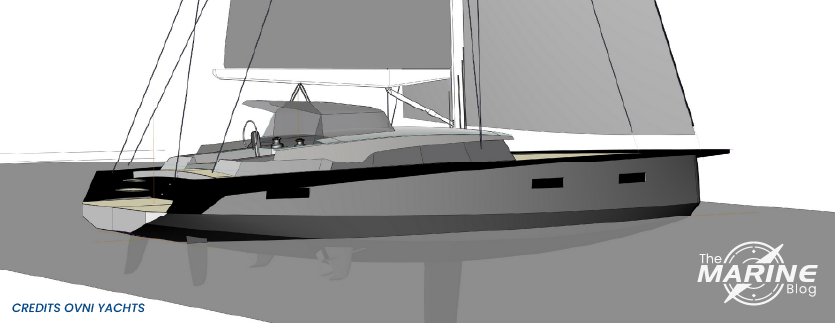
In general, the narrow, tapered waterlines of the past have given way to wider hulls, huge maximum beams and large volumes. Straight lines are favoured at the bow and stern, extending the waterline length and optimising the wetted surface. The maximum beam is generally set very far back to ensure maximum comfort when sailing, especially in a load-bearing gait.
As for the appendages, the keels have shrunk in shape but not in weight. This still accounts for an important percentage of the boat’s overall displacement to the benefit of stability, even in rough seas.
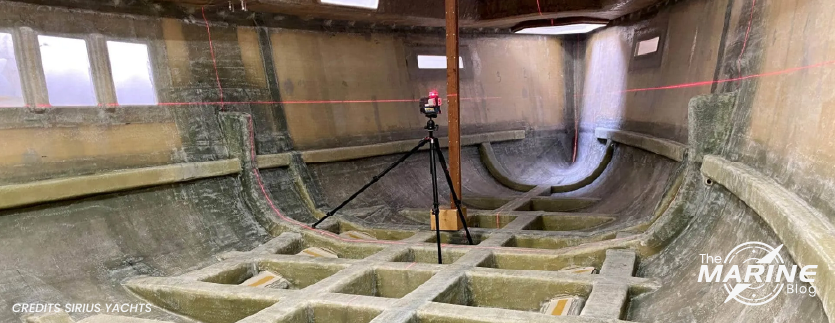
The rudder blades, on the other hand, have become larger and are often double to facilitate manoeuvrability of the cabin cruiser. With regard to the finish of the hull, shipyards are divided between those who prefer to hide the signs of aluminium craftsmanship and those who instead leave them in plain sight, as a distinctive element of the boat
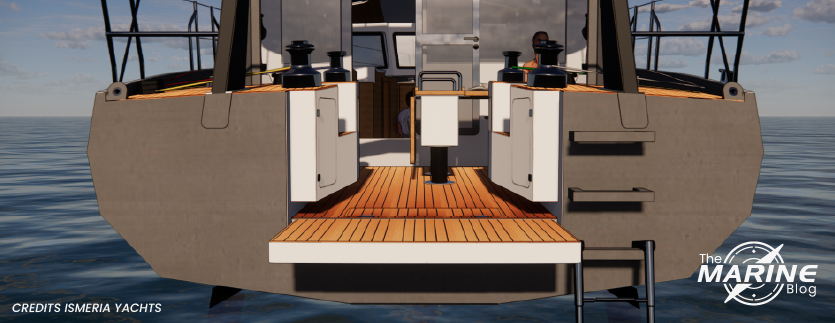
Comfort galore above and below deck
A close consequence of the larger shapes and dimensions of aluminium hulls is the great liveability of both the exterior spaces and below deck. Today’s cockpits on a metal boat are huge, cosy and house, in addition to the helmsman’s stations, large tables and seats, sunbathing areas and spaces dedicated to “living”, such as outdoor kitchens, barbecue areas and aft beaches. These are comfortable and superbly equipped. Also in the stern are raft compartments and garages for the tender or for storing Sup and fishing gear. To ensure maximum protection for the skipper and crew, the cockpit is also extensively protected by hard tops with integrated windscreens to keep dry and warm in all sea and wind conditions.
The interiors are not only large and cosy, they have heights of over 2 metres. They are well lit and rich in quality fittings. Panoramic squares with large windows allowing a 360-degree view of the outside are the main feature. But also increasingly comfortable and well-equipped are the spaces dedicated to cooking, sailing, sleeping and entertainment. The concept on board such aluminium yachts is now to offer the crew comfort and space, just like at home.
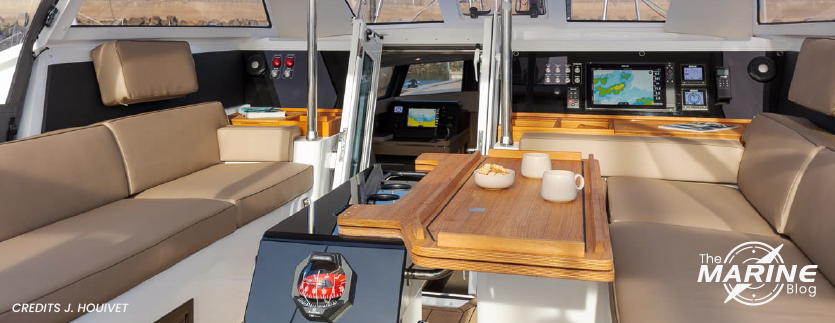
Sailing is easier with Easy Sailing
Mainly thanks to technology, modern aluminium sailing yachts are now much easier to sail than in the past, even with a smaller crew. Lightweight, high-performance composite sails, furling and furling mainsail as standard, electric winches, remote manoeuvres in the cockpit, remote-operated anchor winches, chartplotters with mega screens in the cockpit, bow thrusters. Everything on board these boats is expressly designed to sail comfortably, safely and effortlessly, even in bad weather and even if you are a slightly older sailor.
Those who spend a lot of time aboard these boats, take on long voyages in any weather and with any kind of crew, can count on well-proportioned and dimensioned sail arms that are easy to use quickly and effortlessly.
In short, it is a whole different ball game compared to the past and to the hard, pure sailing that was popular in the past.
Finally, there is one last aspect of the evolution in aluminium boat design that is typical of metal craftsmanship and that is the possibility of customisation. On board these cabin cruisers, much more than on the standard fibreglass boats, everything can be revised and studied for the owner’s specific needs.
This is no small thing, and together with modern design is perhaps the key factor that makes these boats even more attractive and sought after by the cruising enthusiast today.