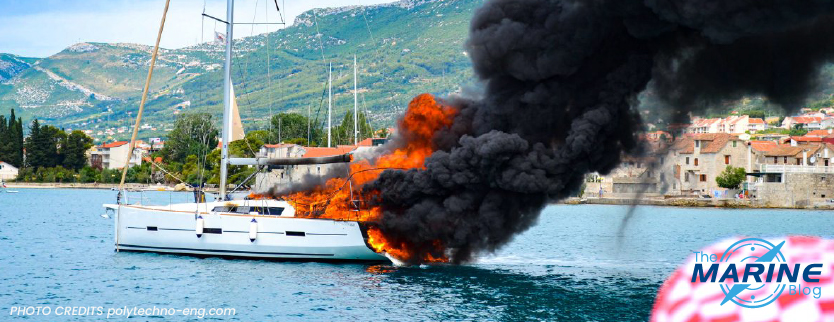
The recent serious fire in the port of Medulin, Croatia, draws attention to the problem of fire prevention in ports and marinas. Here are the measures to be taken, the professionals involved or the fire brigade and state-of-the-art vessels.
The issue of the risk of fire in ports is back in the limelight. On the afternoon of 15 May 2024, a violent fire broke out in the marina of Medulin, a coastal town in northern Croatia located on the Istrian peninsula on the border between Pula and Liznjan. The flames destroyed 22 boats moored in the marina and caused extensive damage, but fortunately there were no injuries. The alarm was triggered at 15.54 and immediately fire brigade operators were on the scene, supported by the Pula Port Authority and the Istrian Police.
Impressive pictures and videos of the fire immediately went around the world, showing boats in the harbour burning in a wave of flames. Local media reported that some boat owners on board at the time dived into the sea to escape the fire, while the fire brigade rushed to tame the blaze and bring the boats not yet affected by the flames out to sea.

22 yachts destroyed in Medulin fire – fire brigade comes to help
It took several hours to put out the fire. Port Authority workers also erected absorbent barriers in the water to contain any environmental damage caused by the wreckage, particularly oil and fuel spills. At the moment, the cause of the incident is not yet known and investigations are underway to ascertain what may have started the fire.
The Medulin marina is a well-known facility for yachtsmen in that part of Croatia and has 85 berths for sailing and motor boats up to 20 metres. It is also equipped with a 24-hour video surveillance system and based on the images recorded by the cameras, the police could reconstruct what exactly happened.
Fire risk in ports: an underestimated problem
The serious incident at the Croatian marina in Medulin once again highlights the problem of fire prevention and extinguishment in marinas. They are high-risk facilities for such events and often do not offer adequate safety systems. The greatest danger for the development of accidental fires in ports and marinas stems precisely from moored boats, on board which flames can be triggered by electrical faults and gas leaks. This risk is exacerbated by the fact that moorings are usually located very close together. Flames from a yacht, thanks to the wind, can spread very quickly to neighbouring boats.
But within a harbour, other fire hazards are present in the vicinity of petrol stations, as well as inside shipyards, garages and workshops, including the adjoining storage facilities for combustible and flammable materials.

Fire-fighting measures in ports and on board yachts
For this reason, every port should, by law, set up an appropriate fire emergency plan, with fire detection systems, as well as deterrent equipment both fixed (hydrants) and mobile (fire extinguishers), sized according to the type of vessels present in the facility. This fire-fighting plan should also be verified with periodic drills and inspections to guide its continuous improvement and adaptation.

The same attention to fire risks should be encouraged on board boats and yachts. The regulations impose on owners a series of specific equipment according to the size of the boat. In particular, three types of extinguishers must be installed. Firstly, powder extinguishers that use special chemical compounds to extinguish flames by suffocating them by eliminating the oxygen that feeds them. Then there are foam extinguishers and finally CO2 extinguishers, which are ideal for extinguishing fires that ignite on electrical systems on board. In addition to carrying such equipment and periodically checking its reliability and maintenance, a skipper’s duties include instructing the crew on the location of fire-fighting devices on board and training them on their operation. As well as rebuking and preventing any careless and dangerous behaviour during normal life on board.
The fundamental role of the fire brigade
In the difficult task of putting out a fire in a port or marina, the work of the fire brigade is fundamental. These are qualified and effectively trained personnel to operate in emergencies and to contain damage to people, yachts, port facilities and, above all, the marine environment.
The difficulties encountered by these professionals when flames develop inside a port are given in particular by the very material from which the boats are built. For example, fibreglass, which is highly flammable and toxic, and by all the internal fittings, including fuel tanks, electrical systems and on-board equipment. Another difficulty for the fire brigade is that of reaching jetties and moorings in a timely manner. Boats are usually moored next to each other, with limited space for movement and the presence of various obstacles (bollards, service columns, trolleys, etc.).

The land and water equipment of the fire brigade
In addition to standard equipment on land, such as tankers, fire hydrants and other flame containment tools, the Fire Brigade can count on a fleet of professional vessels, all with RINA (Registro Italiano Navale) certified construction, classified for national navigation and equipped to deal with any emergency.
In these special vessels, powerful engines are used for propulsion, but also for the operation of the fire pumps on board. Enabling the fighting of fires on ships and yachts with jets of water or foam either with hoses and mobile lances, or with swivelling cannon lances fixed to the deck of the vessels.
Stem Marine’s fire-fighting vessels

In the panorama of shipyards that supply firefighting vessels to fire brigades all over the world, Stem Marine stands out. The company is based in Medesano (Parma) and has over thirty years’ experience in the construction of professional firefighting and rescue vessels. Its naval vessels, hand-built and painstaking in every detail, offer great performance and are equipped with the best technology to make them true operational centres at sea.
Stem Marine’s catalogue of fire-fighting vessels currently includes 3 standard models certified to strict international standards, which differ in length, type of propulsion and equipment. In addition to possible customisation, which is one of the Italian shipyard’s strengths.
Check out the STEM 12 Fire Rescue boat!
Three models from 7.50 to 12 metres agile, solid and well equipped

In the 12-metre bracket is the Stem 12 Fire/Rescue. It is a multi-purpose cabin boat built with vinylester resin and Kevlar reinforcements that can be fitted with diesel or waterjet propulsion. Standard features include hydraulic steering, twin-lever controls, a massive working bollard in the bow and lifting and towing eyebolts. It is also equipped with a 4800 l/min – 10 bar diesel fire pump unit.

In the 10-metre range is the Stem 10, a high-performance multi-purpose open boat designed for emergency manoeuvres in shallow waters. Fast and very manoeuvrable in turns and rotations, it boasts a weight of 5.2 tonnes and has a hull made of fibreglass and Kevlar. Meanwhile the pneumatic ‘D’ section tubulars are foamed and highly resistant. It too is equipped with a 4800 l/min – 10 bar diesel fire pump unit.

Finally, for the boat category there is the Rescue 750 Jet, a 7.50 metre long open water jet boat. It can take up to nine people and has a vacuum-moulded fibreglass hull that floats even when the tubulars are completely deflated. The deck is self-emptying and particularly functional are the hard-top, also in fibreglass, supported by a stainless steel structure and complete with bow lights, as well as the stern platform in marine steel equipped with an ascending ladder. Finally, it is equipped with a 1300 l/min – 10 bar pump. In short, fire prevention and firefighting at sea as well as in ports cannot be separated from adequate legislation, trained and well-equipped professionals, and above all from a rigorous and conscious approach on the part of operators and boaters. Our safety, and not least the health of the sea, depends on it.