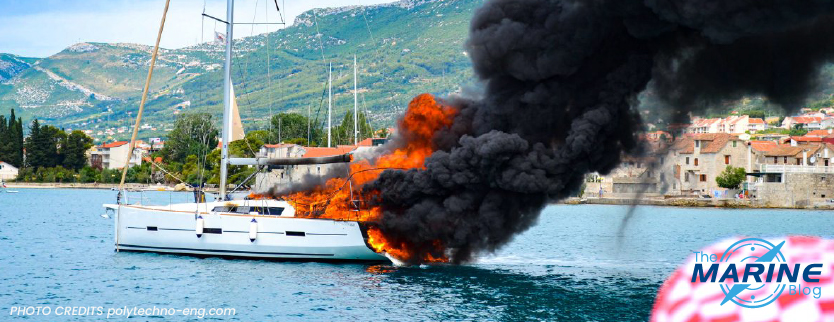
Derived from the merchant navy, crash boxes are now also installed on pleasure yachts, such as the Stem 50, as well as being mandatory on some ocean racing boats. Let’s see what they are and how they save the hull from the risk of sinking following a collision.
When sailing, the danger of collisions with other vessels, rocks, shallow waters, but also drifting objects and debris is very serious and concrete. Statistics over the last few years tell of a progressive increase in collisions at sea. This occurs despite all the technology installed on board and increasingly precise navigation instruments, such as Gps, Radar, Ais systems, etc. It is a problem that mainly concerns areas of high maritime traffic. However, more remote stretches of sea are also affected. This is demonstrated, for example, by the systematic incidents of this kind that occur during ocean races and round-the-world voyages.
Also on the increase are collisions with dangerous containers lost by cargo ships during storms. These large steel containers with a length of 6 to 12 metres are almost never recovered from ships at sea and drift floating on the surface of the water. They are very difficult for skippers and captains to identify. Lately, large cetaceans such as orcas and whales also pose a serious risk of collision. Dozens of episodes have been reported in the chronicles, with hulls even being attacked and sunk by shoals of these giants of the sea.
Among the hardest-hit areas is is undoubtedly the Strait of Gibraltar, where several incidents have occurred. One of the most significant took place in July 2024, when the British yacht Bonhomme William was sunk by a pod of orcas. As reported by The Times, the three-person crew was rescued by the Spanish coast guard.
Safety against collisions and accidents at sea
This is why designers and shipyards try to build vessels capable of resisting impacts and collisions. They equip them with certain technical solutions that, even in the event of collisions and open waterways on board, allow hulls to continue floating or even sailing. We are talking, for example, about the so-called ‘crash boxes’ that considerably increase the safety of hulls. Originally used by passenger and commercial ships, such devices have in recent years also increasingly been found on board pleasure yachts, such as the Stem 50. And they are even compulsory on some cabin cruisers that compete in ocean races and round-the-world races regardless of hull length.

So let’s see exactly what crash boxes are, why they are called that, where they are installed on board and why they are so important for the safety of crews in the event of collisions, leaks and hull accidents.
How do boats and ships float?
For a ship or yacht to maintain hydrostatic equilibrium, the weight of the displaced water mass must equal the weight of the vessel. This is why vessels have optimised weight and shape stability even when the total mass is increased, e.g. when loading crew, equipment, etc.
What happens, however, if the weight of the vessel increases due to an accidental entry of water through a leak? If the additional weight of the water mass is not compensated for by an increase in buoyancy, the risk is that of sinking.

Avoiding hull breaches at all costs
To avoid this type of accident there are preventive actions, such as crew caution and alertness, watch and lookout rosters, and anti-collision technology systems. As well as emergency manoeuvres that can be put in place once an accident has occurred, for example attempting to plug any waterways in the hull through the use of special ballast wedges, quick-setting epoxy putty, and more.
Since, however, the risk of collision at sea remains a constant, to avoid sinking there is the alternative of so-called ‘crash boxes’ installed in the hull. Crash boxes are basically watertight bulkheads that create sealed areas separate from the rest of the hull. When these sections take on water due to a violent collision with rocks or a collision, the watertight bulkhead prevents the water from reaching the other parts of the hull. In this way, the boat continues to float safely and even sail.

The idea of ‘crash boxes’ comes from the so-called ‘compartmentalisation’ used on board large passenger and cargo ships. Watertight bulkheads, i.e. compartments, were introduced by law into the structure of hulls at the end of the 19th century. A ‘corpus’ of regulations and international conventions aimed precisely at regulating the various aspects of navigational safety. Gradually that legislation has evolved and been enriched over time, after various experiences, including dramatic ones, not least the famous sinking of the ‘Titanic’.
The sinking safety of ‘crash boxes
Today, crash boxes are mandatory equipment on board some ocean racing monotypes, such as the Imoca class that participates in the Vendée Globe (non-stop, solo round-the-world race), or on Class 40s.

They can be fitted in various places on the hull, fore and aft, and are also found aboard cruising boats, including catamarans. They usually have a porthole installed on the bulkhead itself that allows the inside of the watertight area to be checked. The watertight area can also house materials, plant and equipment.

Crash boxes’ differ from the so-called “buoyancy reserves”, which are also very common and compulsory on Imoca, Class 40 and Mini 6.50s, for example. The ‘buoyancy reserves’ are parts of the hull that are filled with special, highly buoyant, narrow-cell polyurethane foam that prevents the boat from sinking in the event of shocks and collisions. These sections basically absorb the impact and can even be destroyed without affecting the buoyancy of the boat. According to the various class regulations, they must be numbered, identifiable and installed in precise areas of the hull.
Crash boxes are also installed on the Stem 50
Among the latest generation of pleasure yachts on board which crash boxes are installed is the Stem 50 from the Italian shipyard Stem Marine. This 15-metre aluminium sailing cabin cruiser, designed for the high seas, was created by French naval architect Nicolas Purnu. The Stem 50 boasts no less than two ‘crash boxes’ inserted fore and aft, as in the best ocean-going cabin cruisers.

This solution is expressly dedicated to the boat’s safety. It complements the boat’s construction in aluminium, an extremely solid metal that is already resistant to shocks and collisions. The Stem 50 also features other features, such as the keel and rudders machined from solid for extraordinary resistance even in the event of a collision. In particular, the designers have taken special care to make all the bulkhead passages through which the electrical, water, heating and especially engine ventilation systems pass watertight and collision-proof.
After all, hull safety is a principle that Stem Marine applies to all its boats. On rescue, fire-fighting and patrol vessels, for example, special anti-collision bulkheads are installed.
In conclusion, for all those who sail, being able to count on a collision-proof hull is a great guarantee of safety. The ‘crash boxes’ installed on the hull are, in this respect, an excellent travelling companion. However, what should never really be lacking on board is prudence and awareness of the risks.